


From Maritime Security Data to Operational Action: The SMAUG Control Portal
In February 2025, we presented the vision for the SMAUG Control Portal: an intelligent, user-oriented environment capable of bringing together information from multiple maritime sensing technologies and transforming it into actionable knowledge for port security operators.
At that stage, the Portal was still progressing through its design and early development phases, with interface concepts being refined through an iterative process involving SMAUG technical partners and end users. The ambition was clear, rather than asking operators to interpret fragmented information from multiple independent systems, SMAUG would provide a common operational environment through which maritime activity, potential threats and AI-generated intelligence could be understood and acted upon.
Today, this vision has been translated into an integrated and operational SMAUG Control Portal. Its final implementation brings together sensor information, multi-sensor AI fusion, real-time and historical analytics, system-performance monitoring and AI-supported decision making within a common operational workflow.
From multiple sensors to one operational picture
Maritime security environments generate information from very different sources. Within SMAUG these include underwater, surface, aerial, satellite and vessel-tracking systems. For the operator, however, the value does not come simply from having access to more data. It comes from being able to understand what that data collectively means. This is where the SMAUG AI-Based Fusion and Alert Generation Framework plays an important role.
Individual sensor detections are correlated through a configurable multi-sensor fusion process to generate higher-level combined alerts. Instead of presenting each detection as an isolated technical event, the system can consolidate information from different sources into a more coherent representation of a potential security situation. This intelligence is subsequently made available to the SMAUG Control Portal and the project’s AI-based decision-support components. 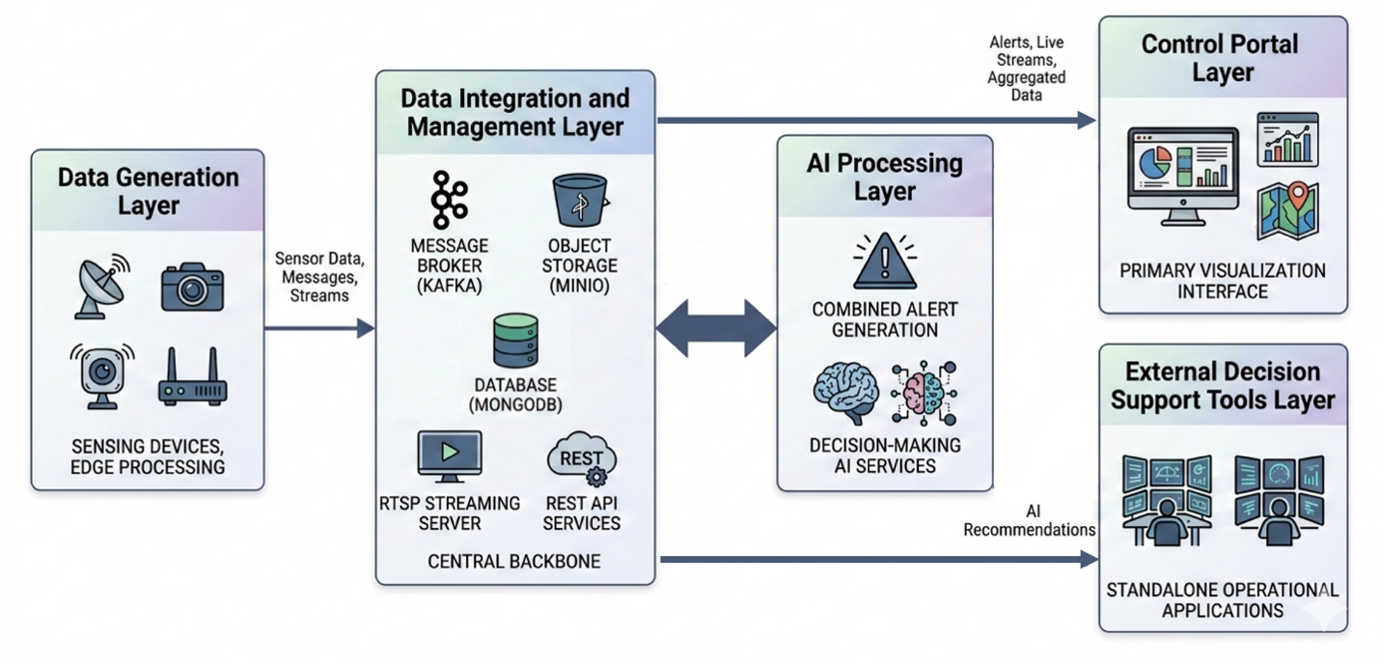 Figure 1 – SMAUG Platform Architecture
The final fusion framework was validated using both synthetic and real operational sensor data and was designed to accommodate heterogeneous sensors, asynchronous information flows and situations where individual sensing devices may be temporarily unavailable.
For the end user, the impact is straightforward, information arriving from multiple technical systems is progressively transformed into a consolidated operational picture that is easier to monitor, investigate and act upon.
A Control Portal designed around the operator
At the centre of the final solution is a map-based operational interface that allows authorized users to monitor maritime activity, sensing devices and generated alerts within the monitored port environment.
The dashboard displays moving vessels, active devices and both individual and combined alerts. Operators can interact directly with the map to inspect vessels, sensors or alerts and retrieve the associated information. Dedicated modules then allow them to move from the overall operational picture into deeper analysis when required.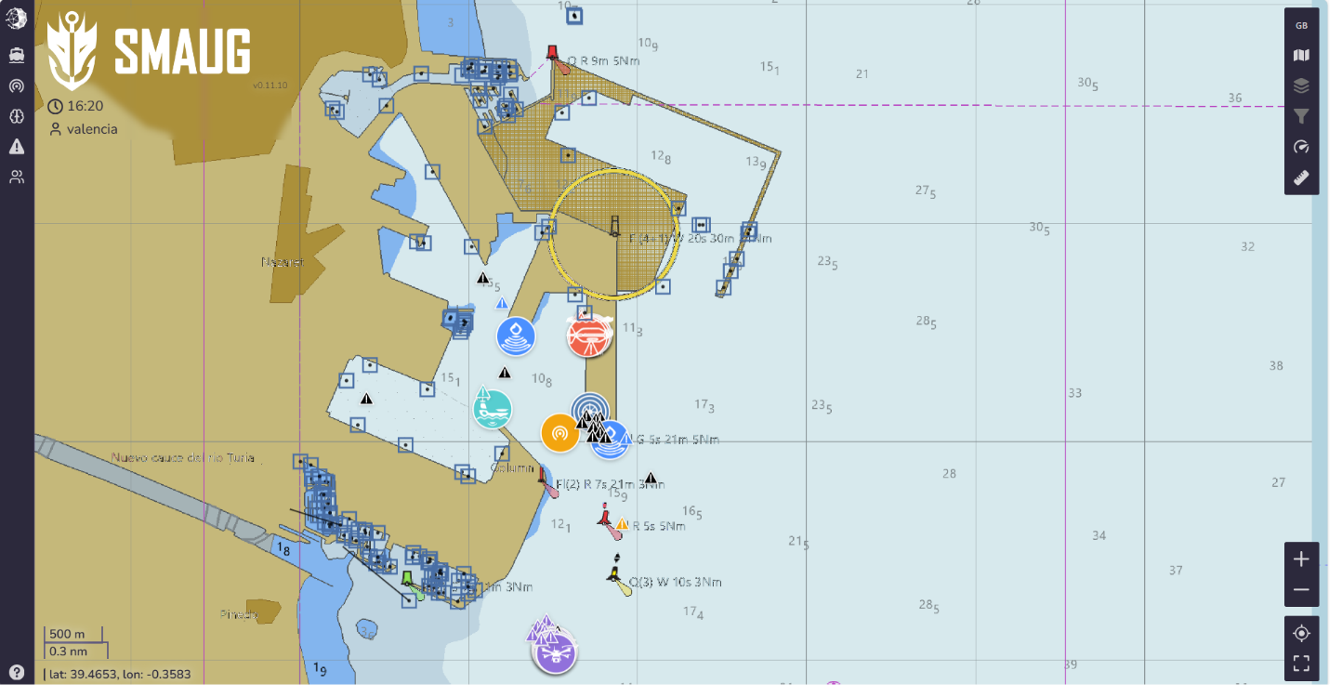 Figure 2 – SMAUG Control Portal Main Dashboard
This means that the Control Portal supports several complementary activities within the same operational ecosystem:
-
- Real-time situational awareness. Operators can observe the latest available information on vessels, devices and security alerts geographically, supporting rapid understanding of where an event is occurring and which assets are involved.
-
- Historical alert analysis. The Alerts Analytics functionality allows users to select time periods and data sources, including combined alerts or individual device notifications, and explore their evolution through timelines, charts and detailed event records. This supports both immediate analysis and retrospective investigation of previous events.
-
- Monitoring the AI system itself. The MLOps Analytics functionality gives users visibility into the stability, performance and operational health of the AI and fusion components. Time-based metrics can help identify changes in model behaviour, anomalies in sensing devices and possible degradation of system performance.
-
- Inspecting the underlying data flows. Through the Dataflow Monitoring functionality, users can inspect live streams as well as structured messages generated across the SMAUG ecosystem. Data can be filtered by use case, topic, port, device or time range, providing a useful capability for verification, operational analysis and investigation of how an event evolved through the system.
Together, these functionalities allow the operator to move from “What is happening?”, to “Why was this alert generated?”, to “How is the system performing?” without having to work across a collection of disconnected monitoring environments.
Keeping the human in the decision loop
A particularly important element of the final SMAUG approach is that AI-supported decision making does not remove the operator from the process. Combined alerts generated by the fusion framework can be processed by the SMAUG AI Decision-Making Engine to produce operational recommendations. These recommendations can then be presented through the complementary iSIM decision-support environment, where the operator can examine the proposed strategy and its geographical context before deciding whether to accept or reject it. The operator can add comments, accept a proposed route or decline the recommendation. Rejection is also communicated back through the system, establishing a feedback mechanism between operational users and the AI-supported decision process.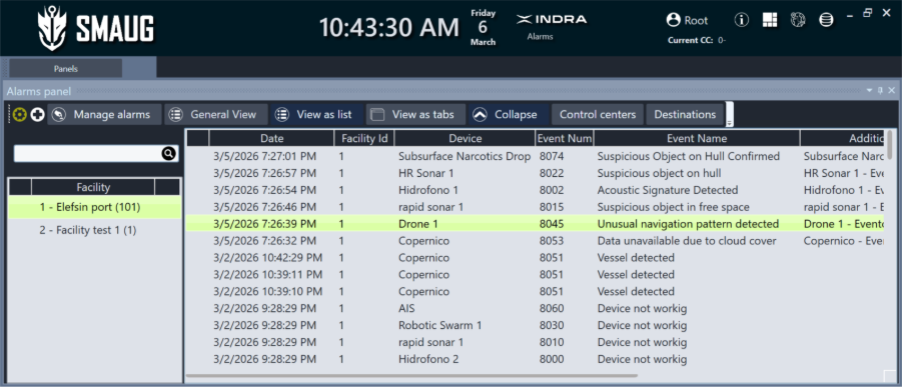 Figure 3 – iSIM Alarms Panel Interface
This human-in-the-loop approach is important for maritime security operations. The role of SMAUG is not simply to generate another automated alert, but to organize evidence, highlight relevant threats and provide decision support while keeping operational authority with the human user.
From expected impact to demonstrated capability
The final results also provide measurable evidence of the progress made since the Control Portal was first presented. The fusion framework achieved the project’s target for identifying potential threats within one minute, with end-to-end fusion and combined-alert processing reported at below one second under typical operating conditions. The framework was also designed to continue generating alerts when individual sensors are unavailable, supporting operation under partial sensor coverage and degraded conditions.
Continuous MLOps monitoring further complements this capability by tracking data and confidence shifts, changes in combined-alert behaviour and operational indicators such as active devices, mean alert confidence and fusion-processing time.
These results demonstrate an important transition for SMAUG: from a concept centred on bringing maritime information together to an integrated digital workflow connecting sensor detection → multi-sensor fusion → combined alerts → AI-supported recommendations → operator visualization and validation.
What this means for maritime security operators
The final SMAUG Control Portal does not attempt to replace the expertise of port security personnel. Its value lies in helping them use increasingly complex digital and sensing infrastructures more effectively. For an operator, this means having a single operational environment from which to monitor maritime activity, identify and investigate alerts, understand information coming from multiple sensing technologies, examine the performance of AI-enabled components and interact with AI-generated operational recommendations.
The result is a more structured path from data to information, from information to situational awareness, and from situational awareness to informed action. This represents the central achievement of the SMAUG Control Portal: transforming the intelligence produced across a complex maritime security ecosystem into information that an operational user can actually understand and exploit.
As SMAUG reaches its final stage, the Control Portal demonstrates how interoperable sensing technologies, multi-sensor AI, analytics and human-centred decision support can be brought together within a common maritime security environment. The platform provides a strong foundation for further exploitation and deployment of integrated, AI-supported approaches to port and underwater security.
A spacial thank you to ITML for their invaluable contribution to this article.