


The Scene
Over 80% of the world’s trade is carried out by sea, constituting maritime transportation as the backbone of global trade. The importance of maritime transport in facilitating international trade makes it fundamental to the world economy and globalisation [1]. In this regard, the continuous movement in the maritime environment demands that port security processes be robust and effective, especially for monitoring and detecting legal and illegal activities in ports, coastal areas, and borders. Illegal goods and drugs trafficking have exaggerated while smugglers have developed new methods which challenge LEAs as current detection means are often no longer effective.
SMAUG Solution
Under these circumstances, the SMAUG (Smart Maritime And Underwater Guardian) project, as its full name reveals, was generated, aiming to develop a solution using multifaceted and state-of-the-art methods to address the ever-changing requirements of legal and illegal monitoring in the maritime environment. By identifying inefficiencies, this novel and inventive method of marine monitoring will address the issue of illicit exploitation and enable the optimisation of lawful activities. In this regard, SMAUG will develop the infrastructure and tools to address these challenges while combating smuggler’s new techniques in the maritime environment.
Are you wondering how?
As a primary goal to improve the underwater detection of any kind of threat in ports and entrance routes, the SMAUG project utilising an integrated system which will provide data regarding threat identification and analysis will achieve its objective by extracting data from 3 main elements.
- Ports security infrastructure
- Advanced underwater detection systems
- Surveillance vessels
In a nutshell, SMAUG will act as an interconnected and heterogeneous guardian for ports, including air, surface and underwater areas!
The guardian is permanently connected to the port and maritime security systems by a continuous improvement cycle thanks to their direct communications and the deployment of CISE nodes. This allows the system to be connected and scan every vessel in the port. An Autonomous Underwater Vehicle Swarm is cost-effective by immersed listening to all port surroundings thanks to their distributed hydrophones with high data redundancy. Simultaneously, the aerial drones will monitor the water’s surface, scanning for anomalous movements. This information will be sent to Maritime Security systems, which, by using AI and machine learning techniques, will identify out-of-normal behaviours and request a more detailed analysis. When this occurs, surface vessels equipped with long-range 3D sonars will perform a “first scan” of the object. These scanned images will be sent to the maritime security system, which predicts potential threats according to the anomalies found on the hulls of the “normalised” ships in the database. In the case of further anomalies, all port and maritime authorities will be simultaneously informed that a closer and more detailed inspection is required. This will be performed by deploying underwater vehicles with short-range scanning to examine the suspicious threat precisely.
All these operations are controlled from a remote location on the port dependencies from where the port authorities can remotely operate every single autonomous robot!
Have a look at the picture below where the SMAUG methodology is depicted!
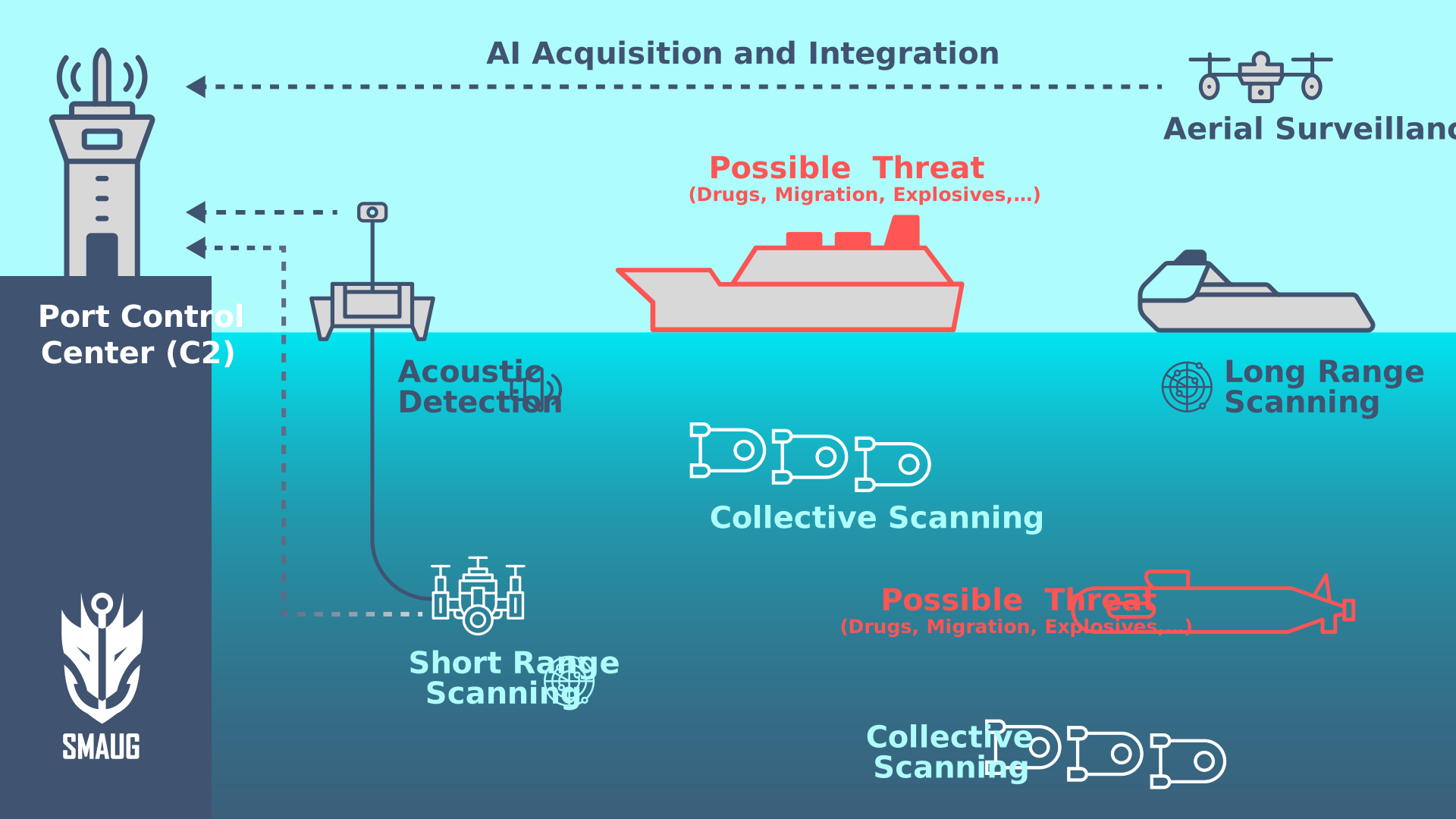
This picture depicts the SMAUG technologies and elements that will transform the project into a guardian for ports. The aerial, underwater and surface technologies are illustrated with links to the port control center!
But there is more! Stay tuned to the SMAUG project by following its social media channels, and don’t forget to subscribe to our newsletter!
- Xiwen Bai, X. Z. (2021). Research topics and trends in the maritime transport: A structural topic model. ELSEVIER: Transport Policy , 11-24. ↩︎